

Dear Colleagues,
System working and collaboration

Shareholding and federation development
We are now approaching the final stages of our shareholding process, which represents an important step in the future development of East Lancashire Alliance. Further correspondence will be issued to practices shortly, outlining the next steps. I would like to thank practices for their patience, engagement and continued support throughout this process.
We have also recently circulated a communication inviting Practice Managers who may be interested in supporting the Alliance to come forward. Practice Managers play an invaluable role within General Practice, and we recognise the experience, knowledge and insight they can bring to the ongoing development of the Federation. We look forward to building on this engagement and strengthening the involvement of practices in our work.
Looking ahead
Nigat Sultana, Chief Executive Officer
Table of Contents
Safeguarding update
Everyone working for, or volunteering with, health organisations have a legal duty to ensure that they effectively safeguard and promote the welfare of children, young people, and their families. Each encounter with a child or their family provides an opportunity to consider their wellbeing, record any concerns, and take appropriate action wherever necessary.
Below, you can find practical guidance to help you develop, improve, and maintain good safeguarding practice.

Training opportunites
As healthcare professionals, it’s important to keep safeguarding skills and knowledge up to date. Below, you can find a reminder about statutory mandatory training requirements and how you can build on this core learning.
- Statutory mandatory training is provided via the e-learning for Healthcare Hub. Please take a moment to visit the Hub and check that your Safeguarding Children Level One and Two learning is up to date.
- Additional safeguarding training is available for anyone looking to enhance their core learning. ELA is currently exploring the possibility of hosting a half-day session from the Child Protection Company as part of practices’ Protected Learning Time (PLT). More details will be shared once confirmed.
Resources, guidance, and further reading
Practical resources and guidance are available to support you in recognising, documenting, and responding to safeguarding concerns. Please note, the resources shared below are intended to complement, not replace, your organisation’s safeguarding policies and procedures.
- Downloadable safeguarding children flowchart – created by QCS
- ‘Protecting children and young people: The responsibilities of all doctors’ – professional standards from GMC
- ‘Child abuse and neglect’ – recommendations and guidance from NICE
- ‘Child maltreatment: when to suspect maltreatment in under 18s’ – recommendations and guidance from NICE
- 10 step guide to sharing information to safeguard children – guidance from ICO
- Non-Accidental Injuries in Babies – Safeguarding Dilemmas
Contacting the safeguarding team
If you have a safeguarding query or require further guidance regarding a child or young person, you can contact the LSCFT Safeguarding Team weekdays between 9am to 5pm.
Morecambe Bay, Lancaster, South Cumbria, Central and West Lancashire:
Telephone: 01772 777 220
East Lancashire, Blackburn with Darwen and Fylde Coast:
Telephone: 01254 283 399
Example case study
Scenario part one:
- A four-month-old child is taken to the GP by their mother who describes the child as irritable and not feeding normally.
- During the consultation, the GP observes a small mark on the child’s upper arm.
- When the GP queries the mark, the mother provides a plausible explanation.
- The child is otherwise healthy.
- The child is not yet independently mobile.
- The GP completes their consultation and does not identify any additional concerns.
- There is nothing in the interaction between mother and child that worries the GP and there are no immediate signs of an emergency safeguarding issue.
Question to consider:
What would you record following this interaction?
Scenario part two:
- Two months later, the child is seen by another healthcare professional for an unrelated issue.
- During their assessment, the clinician notices an abrasion on the child’s lower leg.
- Once again, a plausible explanation is provided by the child’s mother, and no other issues or concerns are noted.
Question to consider:
How do the original clinician’s records support the second in their decision making?
Learning:
In non-mobile infants, injuries and unexplained physical signs warrant particular attention because the child is unable to independently move around and sustain many of the injuries that would be commonplace in an older, mobile child. Even when no immediate safeguarding concerns are present, clinicians should always ensure that key details including observations, explanations, and decision-making processes are objectively documented.
A minor concern, viewed in isolation, may not indicate the presence of abuse or neglect. However, accurate documentation helps to provide a more complete picture – potentially highlighting patterns should further concerns be raised in the future.
Research Team update
Research funding opens
The 2027/28 National Institute for Health and Care Research (NIHR) RDN Strategic Funding Call launches on Tuesday 6th October.
The £45m funding programme will support two priorities under the 10-Year Health Plan for England: developing technologies that enable people to live independently at home, and reducing demand on urgent, emergency and primary care services. Up to £15m will be available for each Strategic Infrastructure Partnership.
The NIHR said the new partnerships are intended to bring together expertise, facilities and resources from across its research infrastructure and the wider health and care system to address challenges that cannot be tackled by individual organisations or disciplines.

Research Huddles on demand!
Can’t attend the next Huddle? Don’t worry. Each session is recorded with a link to watch back circulated after the event. If you have any specific questions or topics you would like us to address, share these with us ahead of time using the email address below and we will try our best to cover as much as we can.
If you would be interested in attending, please email: elalliance.ela.research@nhs.net
Community Nurse Team update
ACP client feedback starting to flow
The Advance Care Planning service continues to grow, with most practices across our region now engaged in the process.
The service has recently introduced a new patient feedback process and has been receiving some great responses back from the patients involved.
“Couldn’t have done anything more to help. More than satisfied. Friendly and helpful from start to finish.”
New feedback cards featuring a prominent QR code are now being shared with patients and their families. When scanned, the QR takes the user to a simple online form that can be completed independently or with our practitioner’s support. Of course, not everyone has a smartphone or access to the web, so the team continues to carry a traditional paper alternative to ensure we capture as much feedback as possible.
The Alliance will be using this feedback to continually improve the service we deliver across our communities and help demonstrate the positive impact we continue to have for those facing life-limiting conditions.
Recent ICB event offers additional insights
One of our practitioners recently attended the education event ‘Ageing well in East Lancashire‘ run by the ICB on the 16th September.
This was a collaborative event with speakers from Pendleside Hospice, ELHT, and the ICB. The event was great for Networking between colleagues and services, raising awareness on Frailty in the local area and really highlighted the benefit of Advance Care Planning and discussions around future care. It was a full day based at Burnley Football Club and a great opportunity to share experiences and learn how we can support people to age well and live well in East Lancashire. This event is being hosted again in Blackburn on the 14th of October for healthcare professionals to attend.
Tickets for the next free event can be booked here.
Advance Care Planning Practitioner walks the walk
An East Lancashire Alliance team member has successfully completed the challenging 26-mile Yorkshire Three Peaks Challenge to raise vital funds for a local hospice.
The challenge, which takes participants across the three iconic peaks of Pen-y-Ghent, Whernside, and Ingleborough, is renowned for testing both physical and mental endurance. Covering 26 miles of demanding terrain, the route requires perseverance and determination from start to finish.


Reflecting on the achievement, the Sarah Drachenberg said:
“Completing the Yorkshire Three Peaks Challenge was an incredible experience. While it was physically demanding, knowing that every step could help support the hospice and the invaluable care it provides kept me motivated throughout. Hospices make a profound difference to patients and families during some of the most difficult times in their lives, and I am proud to have played a small part in supporting their work.”
Hospices rely heavily on charitable donations to continue providing specialist care, emotional support, and dignity to patients and their loved ones. Fundraising initiatives such as the Yorkshire Three Peaks Challenge help ensure these essential services remain available to those who need them most.
Although the challenge has now been completed, there is still time to support the fundraising effort. Every donation, no matter the size, will help the hospice continue providing compassionate care and support across the community.
Those wishing to contribute are encouraged to donate using the link below.
Date set for the next ‘Newly Diagnosed Event’
Our next ‘Newly Diagnosed Event’ will be held on the 20th November at the Leisure Box in Brierfield.
Patients who have recently been diagnosed with Parkinson’s can come along and learn about different symptoms, the importance of staying active, local support groups and more. A range of professionals and support services will be attending the event to ensure patients can access all the information and support they need.
Further details to follow.
Parkinson’s Community Nurse Service expanding
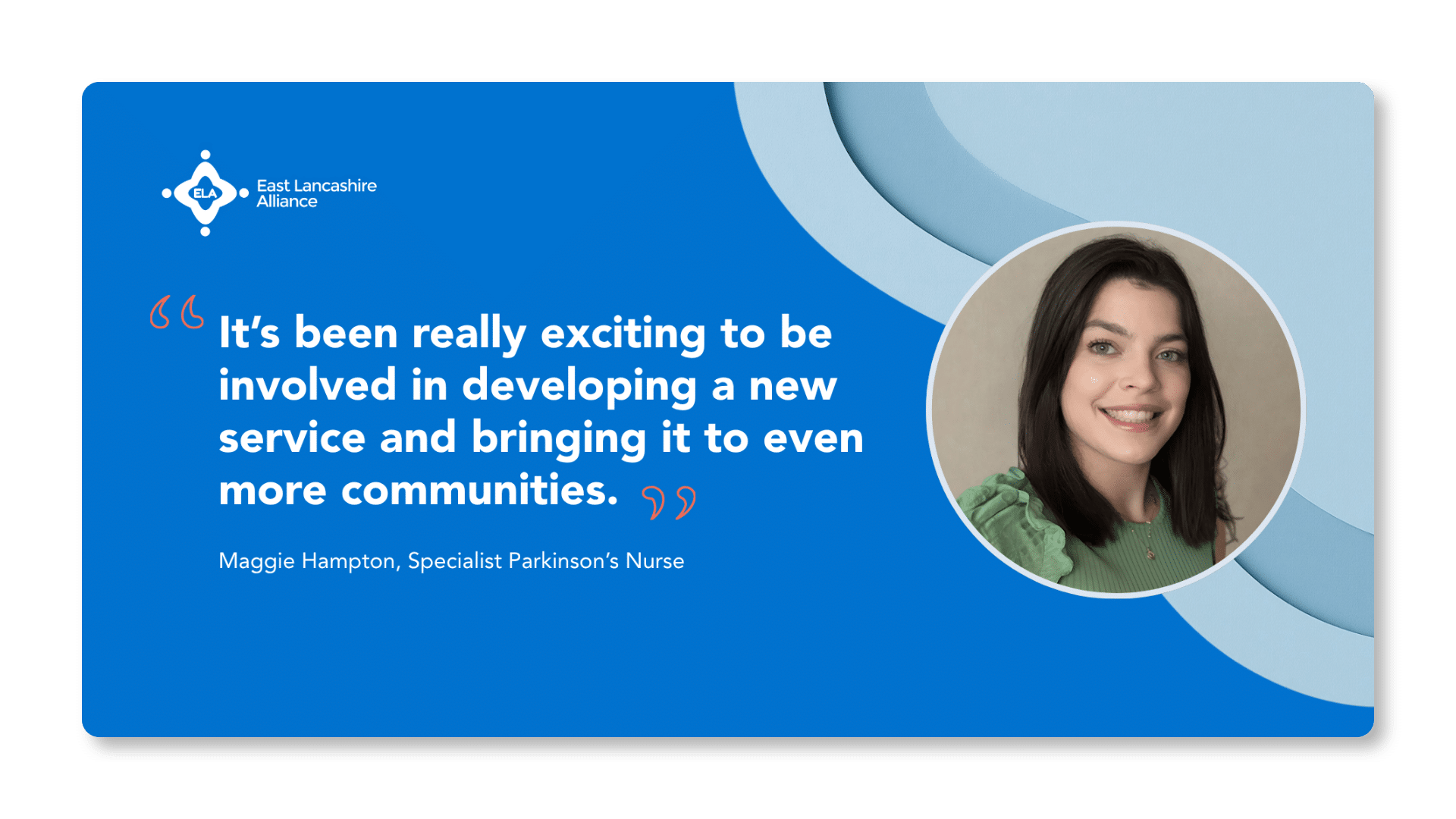
Maggie Hampton joined the Alliance in early July to help expand the Parkinson’s Community Nurse Service into Blackburn with Darwen. Recently, I caught up with Maggie to see how she is settling in.
What initially drew you to the Parkinson’s service?
I was initially drawn to the Parkinson’s service after spending three years supporting people living with the condition. Parkinson’s is an area of nursing I am very passionate about, and I am committed to providing person-centred care.
How are you finding the role so far?
I am really enjoying the role so far. It’s been really exciting to be involved in developing a new service and bringing it to even more communities. At the moment, I am focused on building relationships with local health care teams in Blackburn with Darwen and raising awareness in the local area to ensure people living with Parkinson’s know about the range of support available.
What’s the most rewarding aspect of your role?
I think the most rewarding aspect of the role is yet to come – once I begin directly supporting patients living with Parkinsons and, in time, making a positive difference to their care.
For anyone unfamiliar with the service, what kind of support can the Community Nurse team offer?
Our service supports patients from diagnosis and throughout, providing expert advice, education, and personalised care. We can work alongside a patient’s GP, consultant, and community teams to deliver additional specialist support.
What would be one piece of advice you would offer to someone recently diagnosed with Parkinson’s?
My advice would be not to try and face Parkinson’s on your own. A diagnosis can feel overwhelming, but taking things one step at a time, staying active, and connecting with the right support can make a real difference. Remember, Parkinson’s affects everyone differently, and we’re here to help you find what works best for you.
Clinical Coding Team update
Our Clinical Coding Service continues to provide flexible, high-quality support to GP practices across the region, delivering both short-term and ongoing solutions tailored to individual practice needs.

Our experienced clinical coding team continues to process documents efficiently and accurately in line with the latest coding standards and NHS guidance. By providing timely coding, filing, and forwarding of documentation, the team helps practices reduce administrative pressures, maintain accurate patient records, and support smooth day-to-day operations.
Whether your practice requires additional support during periods of increased demand or is looking for a longer-term coding solution, our service can be tailored to meet your needs.
If you would like to find out more about how we can support your practice, please get in touch:
Paid opportunities for practice-paid personnel:
We are currently offering flexible document coding work for experienced practice-paid personnel. If you would like to be considered for this opportunity, please contact us by clicking the button below:
HR Team update
Third-party harrassment – are you ready?
From 30 October, employers will have a legal obligation to take reasonable steps to prevent their employees being harassed by third parties, such as customers, clients, patients or suppliers.
Employers must be able to demonstrate that they are actively identifying the risks and taking steps to protect their people.
What can you do within your practice to support staff?
- Review your internal policies and procedures to make sure third-party harassment is clearly covered and employees know how to report concerns.
- Conduct risk assessments – Identify situations where employees may be more exposed to inappropriate behaviour from customers, clients or other third parties.
- Train and support your managers so they know how to recognise third-party harassment, respond in the moment, and support any employees affected.
- Keep an evidence trail — record the steps you have taken, any incidents reported and how you have responded. This will help demonstrate that you are taking the issue seriously and reviewing whether your measures are effective.
Useful links for staff:
- Acas gives employees and employers free, impartial advice on workplace rights, rules and best practice. They also offer training and help to resolve disputes.
- NHS Pensions can be contacted using the following methods:
- Email: nhsbsa.pensionsmember@nhsbsa.nhs.uk.
- Online Form: Use the online contact form available on the NHSBSA website.
- Phone: Call the NHS Pension Scheme Helpline at 01253 774774.
- General Inquiries: For pay and pension inquiries, you can call 0303 123 1144, available from 9am to 5pm, Monday to Friday.
Communications Team update
Find the Alliance on social media!
I’m pleased to share that you can now find the Alliance on Facebook and LinkedIn. Through these channels, we’ll be sharing a range of content aimed at both patients and professionals.
Why social media?
- Provides an ideal platform for the Alliance to improve awareness and service uptake among key demographics.
- Offers an opportunity for the Alliance to engage with ongoing discourse within the wider health sector.
- Allows us to build trust, visibility, and influence across East Lancashire.

Recruitment news
Advanced Care Practitioner
The Alliance is currently looking for an experienced Advanced Care Practitioner to join the Burnley West Primary Care Network. This is a fantastic opportunity to join a close-knit, friendly and highly supportive team, offering an excellent salary, NHS Pension Scheme and the chance to make a genuine difference to patient care every day.
Explore the full job description and submit your application using the link below:

Simple Wound Care opportunity
We are looking for Practice Nurses with experience in simple wound care who would be interested in delivering clinics as part of the Alliance’s new LES gap service. The position would offer:- An opportunity to undertake additional paid sessions
- Flexible shifts to fit around existing commitments
- Chance to develop skills in basic wound care
Be sure to check our recruitment page regularly to find the latest opportunities to work with us.
Training opportunities
Spring into action are now offering ‘Learning Disability and Autism Training for Frontline Professionals’. The 3-hour training session aims to build on the Oliver McGowan mandatory training, helping staff put this learning into practice.
Find out more about including how to book below.
Employee Assistance Programme
HA | Wisdom Wellbeing provides 24-hour access to confidential mental health and wellbeing support for you and your immediate family. The service can be used to discuss a huge range of topics including:
- Family issues
- Consumer issues
- Housing concerns
- Bereavement
- Alcohol or drug issues
- Low mood
- Stress & anxiety
- and much more…

Driving quality through partnership.
If you have any questions or would like to feature an update in the next newsletter, please contact: iain.schofield@nhs.net
East Lancashire Alliance, Empire Way, Burnley BB12 6HH